
- What glutathione actually is
- Supplementing glutathione is not the same as making glutathione
- "High-glutathione foods" are not necessarily the entire picture
- The real key is feeding the factory
- Cysteine, sulfur, and the NAC question
- The recycling system: cofactors matter
- What about GlyNAC?
- What to actually do
- References
One of the most talked about substances in natural health right now is glutathione. It is being sold in pills, powders, IV drips, skin-lightening formulas, “detox” programs, and expensive protocols promising everything from liver cleansing to anti-aging.
But most of the marketing is built on one foundational error: it treats the body like a machine that simply needs a missing chemical dumped into it.
That is not how our body works.
You cannot reliably fix your glutathione by simply supplementing. And the foods most often sold as “high in glutathione” may not be the ones that necessarily matter. God designed the body to manufacture this molecule itself, on demand, from raw materials found in real food. And the cascade of effects when it does so transcend the value of the isolated nutrient glutathione.
What glutathione actually is#
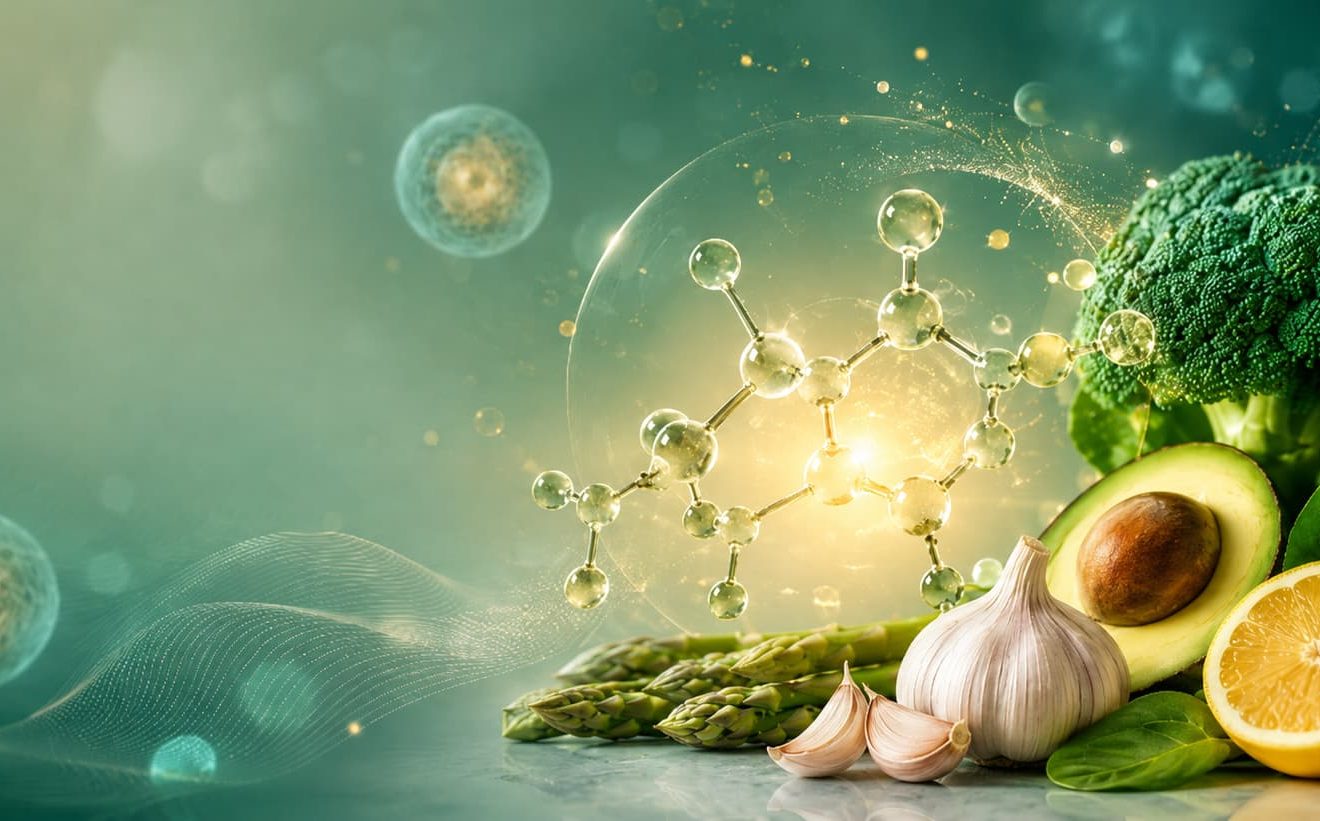
Glutathione is a small protein, a tripeptide, built from three amino acids: glutamate, cysteine, and glycine. Nearly every cell in the body makes its own and keeps it on hand. The highest concentrations sit in the liver, exactly where the body’s main detoxification organ would keep its most important tool [1].
This is why glutathione is often called the “master antioxidant.” Glutathione does at least three important jobs. It neutralizes peroxides and free radicals directly, which is critical because peroxides damage cell membranes, proteins, and DNA when they accumulate. This is why my protocols have never used hydrogen peroxide, despite the influencer push. You are unnecessarily depleting glutathione by using these things. Glutathione also binds mutagenic compounds and toxins so the body can remove them. And it regenerates other antioxidants, including vitamins C and E, recharging them to go back to work [1].
The antioxidant network works as a relay. When vitamin E (specifically α-tocopherol) neutralizes a lipid radical in cell membranes, it becomes a tocopheroxyl radical. Vitamin C (ascorbate) regenerates it back to active vitamin E, getting oxidized itself into dehydroascorbate or the ascorbyl radical in the process. Glutathione then reduces that oxidized vitamin C back to ascorbate, either directly or via enzymes. So the flow is roughly: vitamin E → recharged by vitamin C → recharged by glutathione.
Glutathione exists in two important forms: a reduced, active form (GSH) and a spent, oxidized form (GSSG). A healthy cell keeps almost all of it in the active form. The ratio between GSH and GSSG is one of the clearest indicators of how much oxidative stress the body is under.[2].
This is a self-renewing, self-recycling defense system the body builds and rebuilds for itself. Man has engineered nothing close to it.
Supplementing glutathione is not the same as making glutathione#
The supplement logic sounds simple: glutathione is good, therefore swallowing glutathione must be the solution.
Glutathione is a small protein. The digestive tract breaks it into its component amino acids before it ever reaches the bloodstream intact, which is what it is supposed to do. A placebo-controlled trial at Bastyr University gave healthy adults 500 mg of oral glutathione twice daily for four weeks and found no meaningful improvement in glutathione status and no reduction in oxidative stress markers [3]. One point here: we were never intended to be consuming nutrition through a pill. It can work but it is rarely ideal.
Now it’s not quite as simple as saying oral glutathione never has a positive effect. A six-month randomized controlled trial led by Richie and colleagues in 2015 found that sustained high-dose oral glutathione, up to 1,000 mg daily, did raise body stores over time by roughly 30 to 35 percent [4].
Newer liposomal formulations, which wrap the molecule in a fatty shell to survive digestion, raised blood levels faster in a small pilot trial, with whole-blood glutathione up about 40 percent and a measurable jump in immune-cell activity within two weeks [5]. So oral glutathione is not absolutely useless. But notice what it takes to make it work: high doses, special delivery systems, long-term use, and a manufactured isolate. The body’s own system does this continuously, naturally, and without needing a lab-designed delivery method. The supplement industry is trying to sell people a workaround shortcut for something the body was already designed to do. We simply need to ask, how does our body work and what does it need?
“High-glutathione foods” are not necessarily the entire picture#
There is one study that gets cited often in this discussion, and it deserves attention. Jones and colleagues, writing in Nutrition and Cancer in 1992, measured the glutathione content of the foods Americans actually eat, and it remains the most thorough data of its kind [6]. The study found that asparagus, avocado, okra, raw spinach, and boiled potatoes were among the richer plant sources of reduced glutathione, generally ranging from about 11 to 22 mg per 100 grams. Fresh fruits and vegetables often contained moderate amounts. Dairy, refined grains, and breads carry almost none.
The same study also showed that cooking and processing destroys glutathione. Comparing fresh foods against their canned versions on an equal-weight basis, the losses were often severe. Fresh tomatoes held far more than canned tomato juice. Fresh green beans tested high; canned green beans tested at zero. Across the foods measured both ways, the average glutathione content of fresh preparations was about eight times higher than processed ones, while freezing preserved it reasonably well [6]. The closer food remains to the form God made it in, the more it retains what God put in it. The more man processes it, bottles it, cans it, refines it, heats it, strips it, and stores it on shelves, the more is lost.
Most of the glutathione you eat is broken down before absorption, so you won’t actually just absorb the glutathione and use it directly. The glutathione in your cells is overwhelmingly the glutathione your cells built themselves. This does not mean that glutathione rich plants are useless, because it is still giving you the building blocks. It just means we can’t miss another key step. We need to ask, what foods give the body what it needs to manufacture its own glutathione?
The real key is feeding the factory#
The body builds glutathione from glutamate, cysteine, and glycine. The limiting question is which of the three is hardest to come by, and most research points to cysteine. Glutamate and glycine are generally abundant in the body. Cysteine is often the bottleneck. A controlled human metabolic study showed that when people ate a diet free of sulfur amino acids, their whole-blood glutathione synthesis rate dropped within ten days. [7]. That means the factory slowed down when the sulfur building blocks were removed.
This is why the best glutathione-supporting foods are not always the foods highest in glutathione itself. The best foods are often the sulfur-rich foods that help the body make glutathione. Cysteine is a sulfur-containing amino acid, and the whole system runs on sulfur. The most valuable foods are often not necessarily the ones that test high for glutathione itself, but the ones that deliver cysteine and the sulfur compounds that drive its production. The right solution therefore is not the glutathione supplement but the entire nutrient needs of the body met.
Garlic and onions#
Garlic is the clearest example of why looking at numbers can be very deceiving. It barely registers for glutathione content. Cooked onions test at roughly 0.5 mg of reduced glutathione per 100 grams, near the bottom of the entire vegetable list [6]. This is why most people miss the importance of garlic in glutathione support.
That would be a mistake. Garlic and onions are among the best foods on earth in supporting the body’s own glutathione system. They are dense with organosulfur compounds, substances like diallyl disulfide and diallyl trisulfide in garlic, that help feed the sulfur supply chain the body uses to build and recycle glutathione. These compounds also switch on the body’s antioxidant defenses. In animal tissue studies these garlic and onion compounds raised the activity of glutathione-related enzymes, including glutathione peroxidase and glutathione S-transferase, the enzymes that put glutathione to work [8][9]. Glutathione peroxidase is the cleanup enzyme that uses glutathione to neutralize damaging peroxides before they injure cell membranes, proteins, and DNA. Glutathione S-transferase is a detoxification enzyme that attaches glutathione to harmful compounds, making them easier for the body to disarm and remove. Garlic’s diallyl trisulfide does this through a master cellular switch called Nrf2; when activated, it turns up the body’s whole production line for glutathione and its partner enzymes at once [10]. Aged garlic compounds protect tissues by the same Nrf2 route, and lose that protection in animals whose Nrf2 pathway is disabled [11].
Garlic does not simply provide the body glutathione. It helps turn on and power the body’s own glutathione system by providing the cofactors necessary for the process. That is far more important than a few milligrams of a finished molecule that may be digested before it ever reaches the cells.
Cruciferous vegetables#
The same principle is seen in broccoli, cauliflower, cabbage, Brussels sprouts, and especially broccoli sprouts. Let me digress briefly to state that in my research broccoli sprouts consistently rank highest or near highest for protecting against “viruses” such as ebola.
These foods contain a compound called glucoraphanin, which converts to sulforaphane when the raw plant is chewed or chopped. Glutathione is reduced and lost when processed and chopped but sulforaphane is enhanced when the food is chopped. The conversion to sulforaphane depends on an enzyme called myrosinase that heat destroys, so heavily cooked broccoli loses much of the benefit. Light steaming, eating it raw, or chopping it and letting it rest before cooking preserves it best [12].
Sulforaphane is one of the most studied natural activators of Nrf2, the same master switch garlic uses. It does not act as an antioxidant itself. It acts by triggering the body to increase its own defenses: glutathione synthesis, phase II detoxification enzymes, and other protective proteins[12][13]. Human and cell studies show sulforaphane raising the expression of glutathione-building genes and increasing measured glutathione [13]. In one study, sulforaphane drove cells to import more cysteine from their surroundings specifically to fuel glutathione production [14]. Broccoli sprouts harvested at three to five days old can hold many times more glucoraphanin than mature broccoli, so a small handful of sprouts can do the work of a much larger serving of the mature broccoli[12].
This is how the plants God created work when we use them properly. They do not force the body like a drug. Instead they supply the body and signal the body so the body can do what it was designed to do.
Cysteine, sulfur, and the NAC question#
Because cysteine is often the bottleneck, the supplement industry has focused heavily on NAC, or N-acetylcysteine. It is a modified, more stable form of cysteine. But it is a synthetic, pharmaceutical-derived isolate. NAC is not found in food. It occurs in no plant. It has legitimate medical uses, it is the standard hospital treatment for acetaminophen overdose precisely because it rapidly restores the liver’s glutathione [15]. It is also exactly the kind of isolated, manufactured shortcut that is praised over nature but when you look closer you find that it has side effects that are not present in the form God designed.
The isolate is not necessary, because the body makes cysteine well from whole foods, and can also convert another sulfur amino acid, methionine, into cysteine through established biochemical pathways [16]. The plant foods that supply these sulfur building blocks:
- Legumes: lentils, chickpeas, and beans are among the best plant sources of cysteine [16].
- Seeds: sunflower and sesame seeds are notably rich in it [16].
- Nuts: walnuts in particular, which also tested as the single highest-glutathione food in the entire nut and grain category in the Jones data [6], along with other tree nuts.
- Whole grains: oats and oat bran carry a moderate, steady supply [16].
- The cruciferous and allium vegetables already covered, which feed the broader sulfur pool.
Whole foods provide the materials and the instructions. Isolates try to imitate one piece of the system and seem to excel and outrun nature but in the broader picture we sacrifice. There is no case where man has or can outdo God in design. There is no isolate that outperforms nature, although in many cases it may appear to be so.
The recycling system: cofactors matter#
Building glutathione is only half the system. The body also recycles it. It recharges spent, oxidized glutathione back into its active form, over and over, and that recycling leans on a few supporting nutrients. A shortage of any one of them cripples the operation.
Selenium is one of the most important. Glutathione peroxidase, one of the major enzymes that uses glutathione to neutralize peroxides, requires selenium in its structure. [17]. Without selenium, glutathione cannot do one of its central jobs properly, no matter how much of it you possess. Brazil nuts are one of the richest whole-food sources of selenium. A meta-analysis of clinical trials found that Brazil nuts raised selenium status and increased glutathione peroxidase activity. [18]. One or two Brazil nuts supply a full day’s selenium. Selenium is needed only in trace amounts [18]. Other plant sources include sunflower seeds and whole grains grown in selenium-rich soil.
Vitamin C is the other key recycler. It donates electrons to regenerate oxidized glutathione back to its active state, which is why vitamin C supports glutathione status even though citrus contains no glutathione itself [19]. Supplementation studies have raised glutathione in white blood cells [19].
Vitamin E works with vitamin C to protect glutathione-dependent systems, and the B vitamins, folate, B6, and B12, are required for the pathway that turns methionine into cysteine [16][19]. This is why we need a balanced plant-based diet of plants, nuts, seeds, and whole grains.
What about GlyNAC?#
I am arguably hard on isolates and I stand by it. But there is a new isolate form of NAC that deserves addressing. It is called GlyNAC and it has been studied for years by Dr. Rajagopal Sekhar’s lab at Baylor College of Medicine. The reasoning is straightforward. If cysteine is one bottleneck and glycine is another building block, supplying both may support glutathione synthesis from two directions.
In trials involving older adults, who are often glutathione-deficient, GlyNAC supplementation over several months corrected glutathione deficiency and was associated with improvements in oxidative stress, mitochondrial function, inflammation, insulin resistance, muscle strength, walking speed, and cognition. [20][21]. In aged mice the same approach extended lifespan by about 24 percent [21]. The researchers credit the combined effect of glycine, cysteine, and the glutathione they build, rather than glutathione alone, and call it the “Power of 3” [20].
But slow down a moment…
First, these were studies in older, deficient adults under research conditions
Second, the benefits faded after supplementation stopped.(21) This is an important detail. It means the underlying need did not disappear.
And GlyNAC is just glycine and a cysteine source, the same things we can find in legumes, seeds, nuts, and whole grains. The supplement is an attempt to bottle what a well-rounded whole-food plant-based diet already supplies.
We have seen far greater miracles with garlic than anything I have heard of with GlyNAC and garlic offers a thousands benefits beyond glutathione.
What to actually do#
Strip away the marketing and the picture is plain, and it looks like the way people were always meant to eat.
Eat sulfur-rich foods. Garlic, onions, leeks, broccoli, cauliflower, cabbage, Brussels sprouts, and broccoli sprouts. They directly support the body’s glutathione system.
Do not boil the life out of cruciferous vegetables. Eat them raw, lightly steamed, or chop them and let them rest before cooking so the sulforaphane pathway is preserved. Eat fresh and frozen produce instead of canned and bottled versions. The Jones data is clear: processing severely reduces glutathione content, while freezing preserves much more of it. [6]. The closer to creation, the better.
Eat the building blocks. Garlic, Onions, Lentils, chickpeas, beans, walnuts, sunflower seeds, sesame seeds, oats, and whole grains help supply the sulfur amino acids and related nutrients the body uses to make glutathione.
Cover the cofactors. One or two Brazil nuts a day can supply selenium. Citrus, berries, peppers, kiwi, and cruciferous vegetables supply vitamin C. Nuts, seeds, legumes, and whole grains bring vitamin E and B vitamins with them.
The body was designed to make its master antioxidant itself, continuously and for free, as long as it is given what it needs. Our lack of glutathione is human-made, our solution should be God-made.
References#
- Forman HJ, Zhang H, Rinna A. Glutathione: overview of its protective roles, measurement, and biosynthesis. Mol Aspects Med. 2009;30(1-2):1-12.
- Mannervik B, Carlberg I, Larson K. Glutathione: general review of mechanism of action. In: Glutathione: Chemical, Biochemical and Medical Aspects, Part A. New York: Wiley; 1989:475-516.
- Allen J, Bradley RD. Effects of oral glutathione supplementation on systemic oxidative stress biomarkers in human volunteers. J Altern Complement Med. 2011;17(9):827-833.
- Richie JP Jr, Nichenametla S, Neidig W, et al. Randomized controlled trial of oral glutathione supplementation on body stores of glutathione. Eur J Nutr. 2015;54(2):251-263.
- Sinha R, Sinha I, Calcagnotto A, et al. Oral supplementation with liposomal glutathione elevates body stores of glutathione and markers of immune function. Eur J Clin Nutr. 2018;72(1):105-111.
- Jones DP, Coates RJ, Flagg EW, et al. Glutathione in foods listed in the National Cancer Institute’s Health Habits and History Food Frequency Questionnaire. Nutr Cancer. 1992;17(1):57-75.
- Lyons J, Rauh-Pfeiffer A, Yu YM, et al. Blood glutathione synthesis rates in healthy adults receiving a sulfur amino acid-free diet. Proc Natl Acad Sci USA. 2000;97(10):5071-5076.
- Munday R, Munday CM. Relative activities of organosulfur compounds derived from onions and garlic in increasing tissue activities of quinone reductase and glutathione transferase in rat tissues. Nutr Cancer. 2001;40(2):205-210.
- Belman S, Solomon J, Segal A, et al. Effects of garlic and onion oils on glutathione peroxidase activity, the ratio of reduced/oxidized glutathione and ornithine decarboxylase induction in isolated mouse epidermal cells treated with tumor promoters. Cancer Biochem Biophys. 1989;10(3):213-218.
- Kim S, Lee HG, Park SA, et al. Keap1 cysteine 288 as a potential target for diallyl trisulfide-induced Nrf2 activation. PLoS One. 2014;9(1):e85984.
- Linus Pauling Institute, Micronutrient Information Center. Garlic. Oregon State University. Reviewed 2023.
- Houghton CA, Fassett RG, Coombes JS. Sulforaphane and other nutrigenomic Nrf2 activators: can the clinician’s expectation be matched by the reality? Oxid Med Cell Longev. 2016;2016:7857186.
- Yang Y, et al. Sulforaphane upregulates glutathione biosynthesis genes and increases reduced glutathione via NRF2 in human HepG2 cells. Redox Biol. 2023;67:102918.
- Bieß N, Humpf HU, Behrens M, Gerdemann A. Elucidation of sulforaphane-mediated effects on the cellular human metabolome using metabolic profiling. Mol Nutr Food Res. 2026.
- Mokhtari V, Afsharian P, Shahhoseini M, et al. A review on various uses of N-acetyl cysteine. Cell J. 2017;19(1):11-17.
- Atmaca G. Antioxidant effects of sulfur-containing amino acids. Yonsei Med J. 2004;45(5):776-788.
- Brigelius-Flohé R, Maiorino M. Glutathione peroxidases. Biochim Biophys Acta. 2013;1830(5):3289-3303.
- Cardoso BR, Duarte GBS, Reis BZ, Cozzolino SMF. Brazil nuts: nutritional composition, health benefits and safety aspects. Food Res Int. 2017;100(Pt 9):9-18. See also meta-analysis: Effect of Brazil nuts on selenium status, blood lipids, and biomarkers of oxidative stress and inflammation. Antioxidants (Basel). 2022.
- Johnston CS, Meyer CG, Srilakshmi JC. Vitamin C elevates red blood cell glutathione in healthy adults. Am J Clin Nutr. 1993;58(1):103-105.
- Kumar P, Liu C, Hsu JW, et al. Glycine and N-acetylcysteine (GlyNAC) supplementation in older adults improves glutathione deficiency, oxidative stress, mitochondrial dysfunction, inflammation, insulin resistance, endothelial dysfunction, genotoxicity, muscle strength, and cognition: results of a pilot clinical trial. Clin Transl Med. 2021;11(3):e372.
- Kumar P, Liu C, Suliburk J, et al. Supplementing glycine and N-acetylcysteine (GlyNAC) in older adults improves glutathione deficiency, oxidative stress, mitochondrial dysfunction, inflammation, physical function, and aging hallmarks: a randomized clinical trial. J Gerontol A Biol Sci Med Sci. 2023;78(1):75-89.